

Every successful trader eventually learns one uncomfortable truth: losses are inevitable. What separates professionals from gamblers is not avoiding losses, but controlling the size of their losses. The stop-loss is the single most important tool that makes this possible.

Losses Don’t Work Linearly — They Work Geometrically
Most beginners think:
“If I lose 10%, I just need to gain 10% to come back.”
That assumption is dangerously wrong.
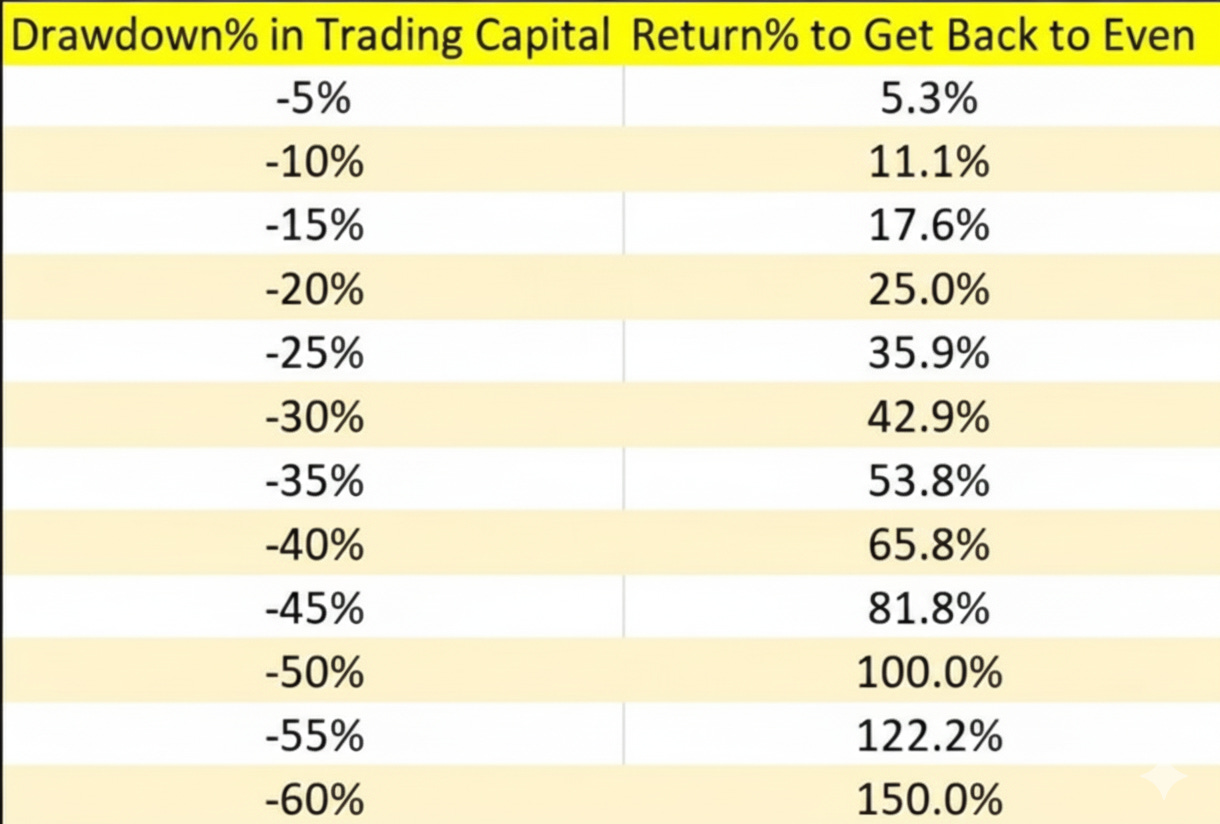
Losses compound geometrically, not arithmetically.
Lose 10% → need 11.1% to recover
Lose 20% → need 25% to recover
Lose 50% → need 100% to recover
Lose 70% → need 233% to recover
As losses deepen, the recovery curve becomes exponentially steeper. At some point, recovery is no longer practical; it becomes statistically improbable.
Below is the most widely used and professionally accepted stop-loss rule, the Risk Per Trade Rule. This single rule alone protects you from geometric drawdowns.
Never risk more than 0.5%–1% of total capital on a single trade.
Example:
Capital = ₹10,00,000
Max risk per trade (1%) = ₹10,000
Always remember that if you ignore stop loss, geometry takes over and capital disappears fast.